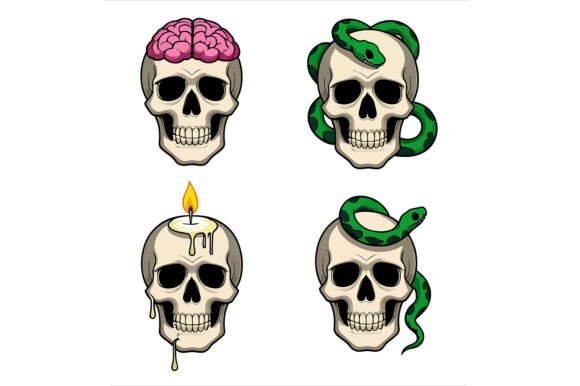
Vector Art of Set of Skulls: A Guide to Smart Design Choices
Skull imagery has long been a staple in graphic design, representing everything from edgy rebellion and mortality to intricate artistic expression and gothic elegance. When you are looking for Vector Art of Set of Skulls, you are likely seeking more than just a picture; you need a versatile asset that can scale from a tiny favicon on a website to a massive billboard without losing definition. This specific collection offers exactly that flexibility. It is not merely a static image but a dynamic tool designed to adapt to your creative vision, whether you are launching a new apparel line, designing custom stickers, or creating educational materials.
The true value of this set lies in its technical foundation. Unlike standard raster images that pixelate when enlarged, these illustrations are built on mathematical paths. This means you can resize them infinitely, change the color palette to match your brand guidelines, and isolate individual elements for complex compositions. However, possessing the file is only half the battle. Many creators overlook critical details during the selection and application process, leading to wasted time, poor print quality, or legal ambiguities. Understanding how to leverage these assets correctly is what separates a professional result from an amateur one.
Common Pitfalls When Selecting Vector Assets
One of the most frequent mistakes designers make is confusing "vector" with "high-quality." Just because a file claims to be a vector does not guarantee it is well-constructed. You might download a file labeled as EPS, only to find it is actually a low-resolution JPEG embedded inside a vector container. This happens often with poorly curated marketplaces. If you attempt to scale such an image, the moment you exceed the original resolution, the edges will become jagged and blurry, ruining the crisp aesthetic required for professional work.
With the Vector Art of Set of Skulls, this risk is mitigated because the files are fully editable and genuinely vectorized. However, you must still verify the file structure upon opening. Check if the paths are clean and if the colors are defined by swatches rather than hard-coded hex values. If the artwork is a mess of thousands of tiny anchor points, it will slow down your software and complicate any editing you wish to do. A well-optimized vector file allows for smooth manipulation, whereas a bloated one can crash your system or make simple tasks like changing a skull's eye color a frustrating ordeal.
The Trap of AI-Generated Concepts Without Human Refinement
Another area where confusion often arises is the origin of the design. The rise of AI tools has flooded the market with concept art that looks impressive at first glance but fails under scrutiny. Many users assume that because an image was generated by AI, it is ready for commercial use immediately. This is a dangerous assumption. Raw AI output often contains hidden artifacts, inconsistent geometry, and licensing gray areas that can lead to copyright disputes or unprofessional results.
This specific set addresses that concern directly. While the initial concepts were inspired by AI, the final product has been fully vectorized, resized, and carefully edited by a human designer. This hybrid approach combines the speed of generative ideas with the precision of manual craftsmanship. When evaluating similar assets, always ask: "Has a human verified the geometry?" If the answer is no, you risk ending up with a logo that looks distorted when printed on a t-shirt or a poster where lines don't align perfectly. The extra step of human refinement ensures that the Vector Art of Set of Skulls meets industry standards for print and digital production.
Optimizing Your Workflow for Print and Digital Use
Once you have secured a high-quality file, the next challenge is applying it correctly. A common error is using the wrong file format for the intended medium. For instance, using the included high-resolution JPEG for a large-format print job is a recipe for disappointment. While the JPEG is perfect for quick previews, web graphics, or social media posts, it lacks the scalability needed for posters or apparel merchandise.
To avoid this, reserve the JPEG for situations where speed is essential and print resolution is not a factor. For anything involving physical production—such as crafting DIY projects, creating wall art, or producing logos for branding elements—you must utilize the EPS file. This format preserves the vector data, allowing printing presses to render the image at 100% fidelity regardless of size. By understanding the distinct roles of each file type provided, you ensure that your project maintains its integrity from the screen to the final product.
Color management is another subtle detail often overlooked. When working with vector skulls, the default colors may not match your brand's specific Pantone codes or CMYK requirements. Because this set is fully editable, you have the freedom to adjust these parameters. Do not simply accept the default palette. Take the time to convert the colors to the appropriate mode for your output. If you are designing for a printer, switch to CMYK to prevent unexpected color shifts. If you are designing for the web, RGB will provide the vibrant pop necessary for digital engagement.
Strategic Application in Branding and Merchandise
The versatility of this skull set makes it ideal for entrepreneurs and small business owners looking to establish a strong visual identity. However, overuse or poor placement can dilute the impact. A skull motif is powerful, but it should serve a purpose within your design narrative. Whether you are creating greeting cards, invitations, or scrapbooking layouts, consider the context. A detailed, intricate skull might overwhelm a minimalist invitation, while a simplified version could be perfect for a bold t-shirt graphic.
Before finalizing your design, visualize the end product. Will the details of the skull remain visible when shrunk down to the size of a sticker? Does the contrast hold up when printed on dark fabric? These are practical questions that determine the success of your project. The ability to customize details in the EPS file gives you the control to answer these questions affirmatively. You can simplify complex areas for smaller applications or enhance textures for larger displays.
What to Verify Before You Download
Before committing to any purchase or download, take a moment to review the deliverables against your specific needs. Ensure that the package includes both the editable EPS file and the preview JPEG, as having both provides the best of both worlds. Check the license terms to confirm that the design is suitable for commercial use, especially if you plan to sell products featuring the artwork. Since this illustration is an original creation with clear attribution regarding its AI-assisted origins and human refinement, it offers a level of transparency that builds trust.
Furthermore, assess your own software capabilities. To get the most out of the EPS file, you need compatible vector software like Adobe Illustrator, CorelDRAW, or Inkscape. If you are a beginner, ensure you have access to tutorials or resources on how to manipulate vector paths. The learning curve is worth it, as the flexibility gained opens up endless possibilities for customization. By approaching your design project with these checks in place, you avoid costly reworks and ensure a smooth creative process.
In summary, the Vector Art of Set of Skulls is more than just a decorative element; it is a robust resource for creators who value quality and adaptability. By avoiding common pitfalls like ignoring file formats, overlooking the importance of human refinement, or neglecting color management, you can maximize the potential of these assets. Whether you are a seasoned professional or a hobbyist starting your first print-on-demand store, making informed decisions about your design tools is the key to achieving professional, polished results.